About the Isavia group
About Isavia ohf.
Operations
Isavia ohf. is responsible for the development and operation of Keflavík Airport. Its subsidiaries, Avians operate air navigation services in one of the world's largest air traffic control areas and Isavia Regional Airports ehf., that operate robust network of domestic airports in Iceland.
Executives
Isavia ohf. Executive Committee.
.jpg&w=3840&q=80)
Sveinbjörn holds a B.Sc degree in economics from the University of Iceland. He worked at the Investment Bank of Iceland and in risk management at Icelandair 1999–2005, was CFO of FL Group 2005–2008 and COO/CFO of Clara 2011. He became Isavia’s CFO in 2013 and CEO in 2019.

Bjarni Örn holds a B.Sc. in Computer Science from Reykjavík University and an MBA from Waseda University, Japan. He worked for Origo and Arion Bank before joining Össur as Director of IT in 2019. He became Chief Digital Development & IT Officer in 2022.

Bjarni Páll holds an MBA from the University of Iceland and is a licensed air traffic controller. He has worked for Isavia and its predecessors since 2001 in air traffic control and airport operations. He was Director of Airport Control at Keflavik Airport 2020-2023 and Director of Airport Operation 2023-2026. He was appointed Chief Service and Operations Officer in January 2026.

Elísabet holds a B.A. in Literature and an MS in HR Management (University of Iceland) and an APME in Project Management (Reykjavík University). She worked at Hagvangur 2006–2017, joined Isavia as HR consultant in 2017, became HR Manager in 2019 and Assistant to the CEO in 2021. She was appointed Chief People and Culture Officer in January 2026.

Hrönn holds a B.A. in Sociology, M.A. in Advertising Management, M.Sc in Social Research and an MBA. She was Director of Business Development and Marketing at Keflavik Airport 2002–2008, Director of Customer Service at Skeljungur in 2008–2009, and Business Manager at Harpa 2009–2012. She has been a Director at Isavia since 2013. She joined the Executive Board in January 2026.
.jpg&w=3840&q=80)
Ingibjörg holds a Cand.Oecon. in business administration from the University of Iceland and a master’s in finance from Cass Business School. She was Director of Finance & HR at Valitor 2008–2016 and at Icelandic Banks’ Data Centre 2016–2020. She became Chief Finance & HR Officer at Keflavík Airport in 2020, and CFO in January 2026.

Maren holds a BSc in Industrial Engineering from the University of Iceland and has completed further studies in leadership, operations and finance. She joined Isavia in 2012 and was Director of Facilities & Infrastructure 2020-2026. She was appointed Chief Airport Development and Infrastructure Officer in January 2026.

Ómar holds a Cand.Oecon in business administration from the University of Iceland. From 2009 to 2014, he served as CEO of Vodafone Iceland. Ómar then took on the role of Executive Director of Sales and Consulting at Sjóvá, a position he held until 2017, when he was appointed CEO of Securitas Iceland. He worked there until 2024. Ómar joined the executive management team in April 2026.
Subsidiaries
We have two independent subsidiaries: Avians and Reykjavík Regional Airports ehf.. These companies are wholly owned by the parent company. They set their own corporate policy but work in accordance with most of the parent company's support policies. This is in line with the ownership policy of Isavia's subsidiaries. The executive committee of each subsidiary is responsible for implementing its corporate policy.
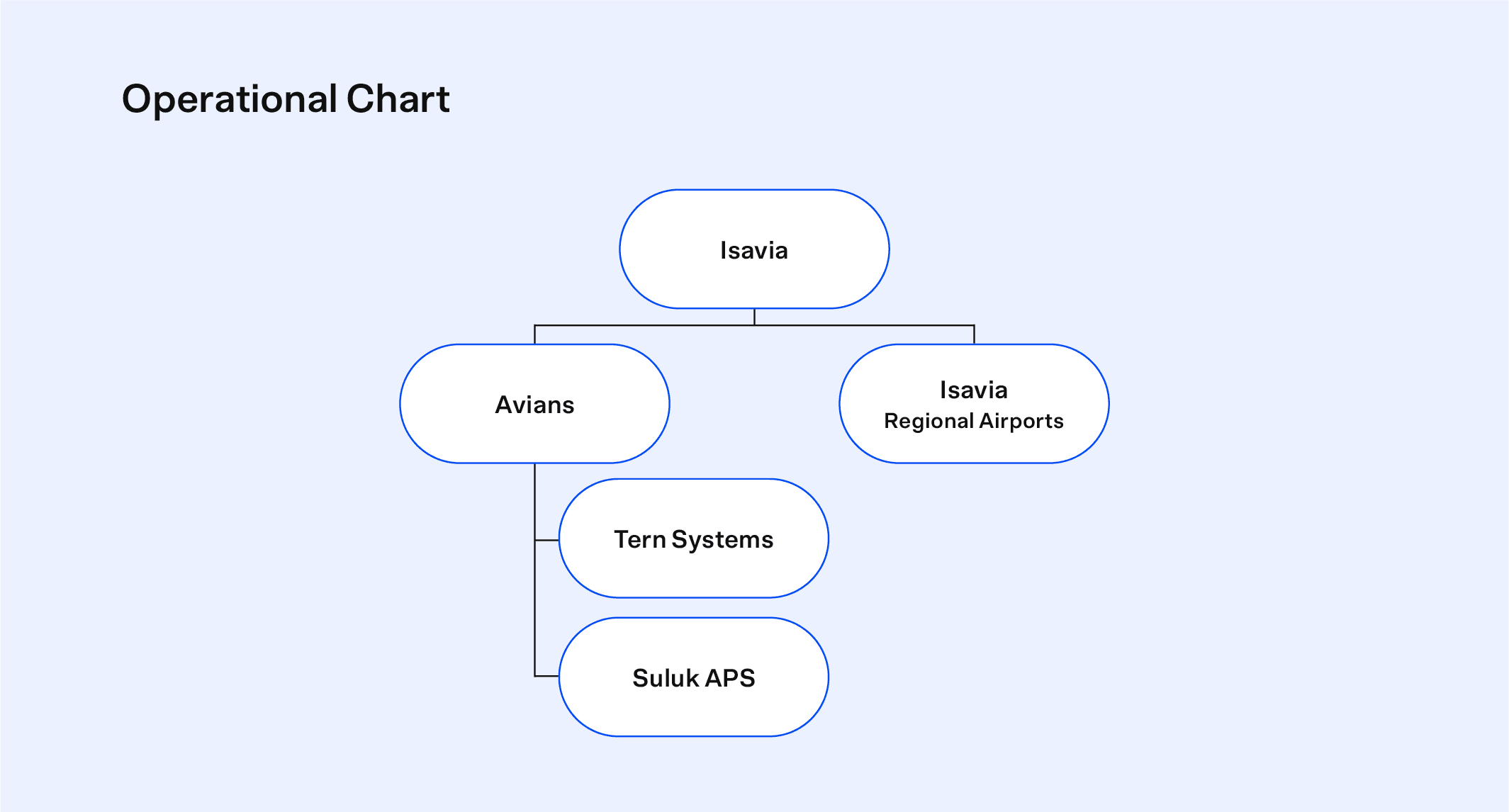

Provides air navigation services for domestic and international flights in air navigation areas over the North Atlantic. The company operates a special training department for air traffic control, air communications, flight data science and flight information services. As well as carrying out flight test projects in Iceland, Greenland and the Faroe Islands.

Reykjavík Domestic Airports ehf. runs the operation of Icelandic airports other than Keflavík Airport (KEF). The operation is based on the company's service agreement with the Ministry of Infrastructure, which determines the service level of the airports, operation and maintenance, as this is part of a public transport system owned by the state.
Key Figures
Passengers
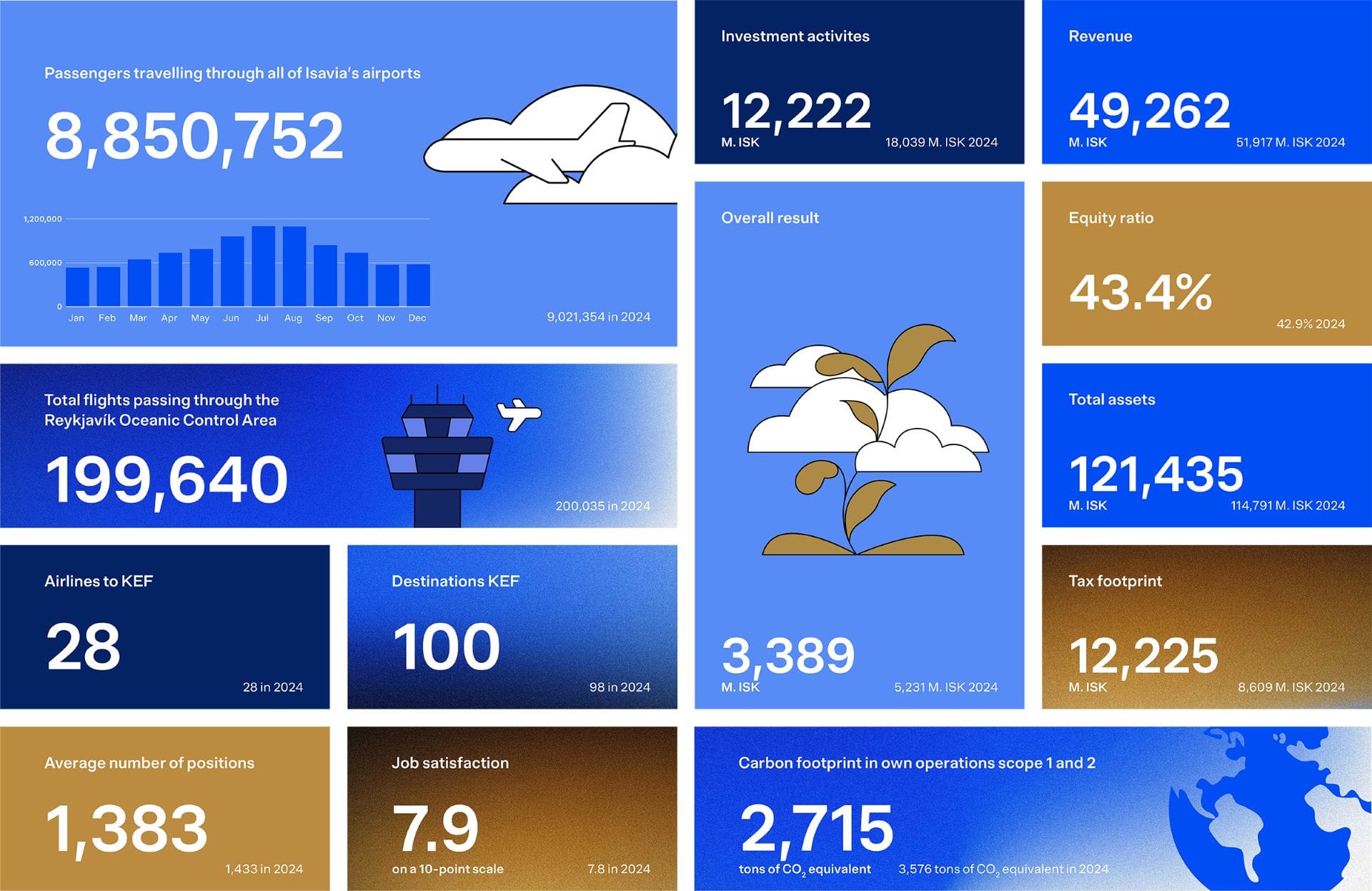
In 2025, the total number of passengers travelling through Isavia-operated airports amounted to just over 8.8 million, representing a 1.9% decrease compared to 2024.
Passenger numbers decreased by 2.0% at Keflavík Airport and by 5.4% at Reykjavík Airport. In contrast, passenger traffic increased at Akureyri Airport by 7.6% and at Egilsstaðir Airport by 0.8%.
The total number of international passengers travelling through Icelandic scheduled airports declined from just over 8.3 million to approximately 8.2 million, a 1.9% year-on-year decrease. Growth in international traffic at Akureyri Airport was particularly strong, with an increase of 33.6%.
The number of domestic passengers decreased from nearly 653,000 to just over 637,000, a reduction of 2.3% compared to the previous year.
Aircraft Movements
Overall passenger trends in 2025 were reflected in aircraft movements across Isavia’s airport network. While activity declined at Keflavík and Reykjavík Airports in line with reduced passenger volumes, increased traffic at Akureyri and Egilsstaðir Airports contributed to a more balanced overall development within the airport system.
Cargo Transport
In 2025, a total of 64.9 thousand tonnes of cargo passed through Isavia-operated airports, marking a 5.5% increase compared to the previous year.
International cargo transport accounted for 63.7 thousand tonnes, an increase of approximately 5.6% year-on-year. Domestic cargo volumes also grew, increasing by 1.7%, from 1,207 tonnes to 1,227 tonnes.
Air Traffic Management
A total of 199,640 aircraft passed through the Icelandic air traffic control area in 2025, representing a 0.2% decrease compared with 2024, which was a record year with 200,035 aircraft.
Aircraft operating in the Icelandic Oceanic Control Area flew a combined distance of over 281 million kilometres, a 0.1% decrease compared to the previous year. Traffic to and from Iceland accounted for 33% of total movements, while overflights represented 67%.
More than one-third of all transatlantic air traffic between Europe and North America transits through the Icelandic airspace, which is managed by Avians, Isavia’s air navigation service provider.